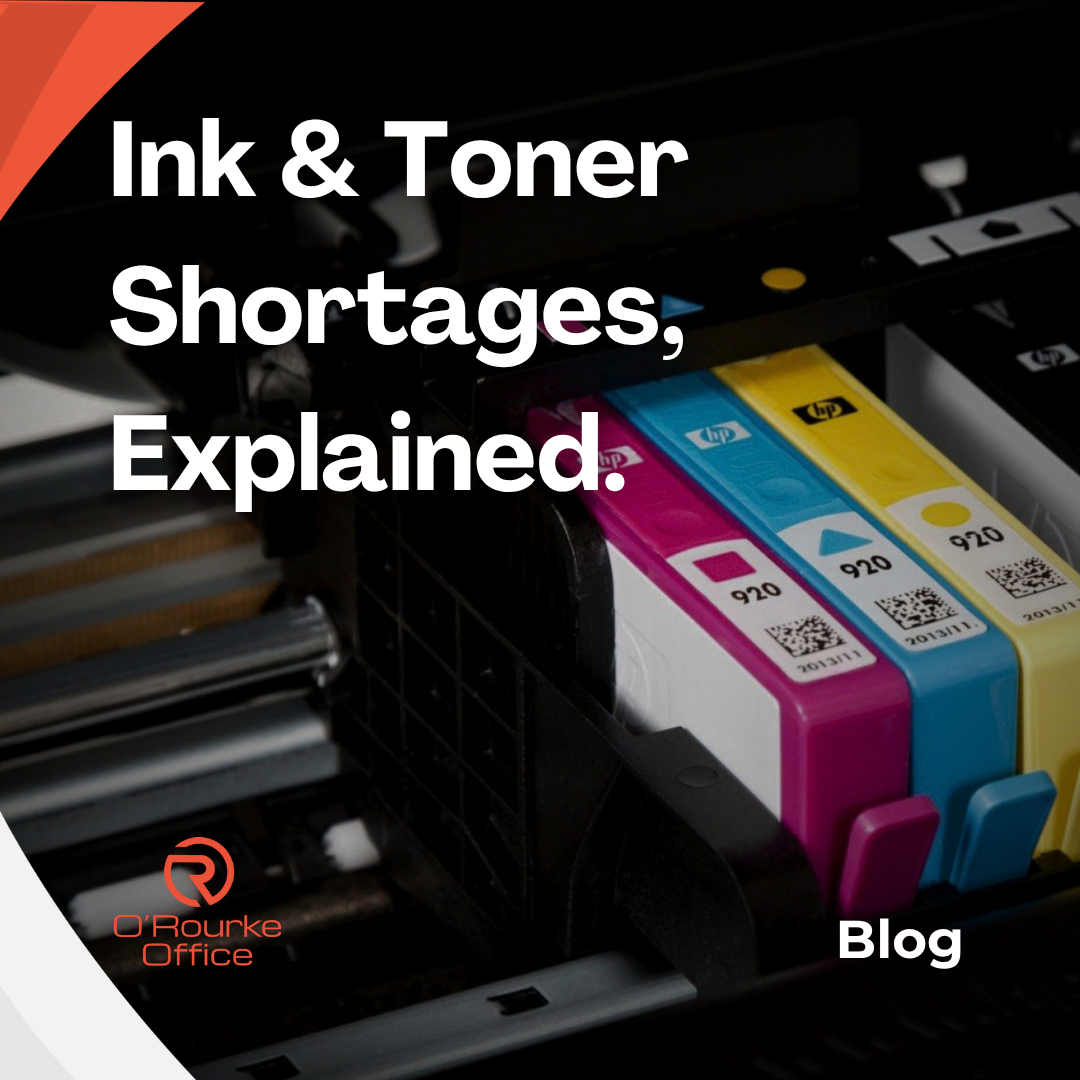
Throughout 2026, the ink and toner supply chain has faced a combination of raw-material pressures, higher costs, shipping disruption, trade restrictions and changes in the printer market.
For Irish schools and businesses, this can mean higher prices, longer lead times and less certainty about cartridge availability.
So, what is causing the problem, and what can you do to avoid running out of essential printer supplies when you need them most?
A Changing Ink & Toner Market
The global ink and toner cartridge market remains a huge industry, with billions of cartridges and supplies used by businesses, schools and households every year.
While digital communication has reduced some types of printing, printers and multifunction devices remain essential for many organisations. Schools still need to print worksheets, exams and reports, while businesses rely on printers for invoices, documents, labels and everyday administration.
At the same time, 2025 and 2026 have brought increased pressure across the supply chain.
Many buyers are experiencing:
- Higher prices, particularly on original OEM cartridges.
- Longer delivery times for popular and newer cartridge models.
- More frequent stock shortages and back-orders.
- Less certainty around when constrained products will become available.
- Changes to the availability of compatible and remanufactured cartridges.
For organisations that rely heavily on printing, even a short delay can become a problem.
Why Are Ink & Toner Prices Rising?
There isn’t one single reason behind the current pressure. Instead, several factors are affecting the cost and availability of cartridges.
1. Raw Material Costs
Ink and toner cartridges depend on a range of chemical and petroleum-based materials, including resins, pigments, binders, additives and other specialist ingredients.
When the cost or availability of these materials changes, manufacturers face higher production costs.
Toner powder is particularly dependent on specialist materials, with resins and carbon black among the important components used in production.
Supply restrictions, higher energy costs, geopolitical uncertainty and longer lead times for some materials can all feed through into the final price of a cartridge.
For customers, this can mean higher list prices and less predictable availability.
2. Shipping & Global Supply Chains
Ink and toner products often travel through several stages before reaching an Irish customer.
Products and components may be manufactured in Asia, shipped to Europe, processed through distribution centres and then transported to Ireland.
Disruption anywhere along that journey can result in delays.
Geopolitical tensions and disruption to major shipping routes have also increased freight, insurance and transit costs in some areas.
For Irish businesses and schools, this makes having a reliable supply chain particularly important.
3. Tariffs, Trade & Customs
Changes to international trade policies can also affect the cost of printer supplies and their components.
Products moving between Asia, Europe and North America can face additional tariffs, customs requirements and administrative costs.
For suppliers, these additional costs can ultimately affect the price paid by customers.
Ireland also has the added consideration of importing many printer supplies from outside the country, meaning international logistics can have a direct impact on local availability.
4. Chips & Cartridge Technology
Modern printer cartridges are more than just plastic containers filled with ink or toner.
Many contain electronic chips that communicate with the printer and provide information such as cartridge identification, toner levels and compatibility.
The availability of these electronic components can therefore affect cartridge production.
At the same time, printer manufacturers are increasingly controlling how their machines interact with third-party cartridges.
This has created additional challenges for some compatible and remanufactured cartridge suppliers.
What Does This Mean for Businesses?
For customers, it can mean that a cartridge which was previously easy to source may suddenly become:
- Temporarily unavailable.
- More expensive.
- Subject to a longer lead time.
- Replaced by a newer reference.
- Available only through an alternative OEM or compatible option.
This is particularly relevant for newer printer models and high-volume cartridges.
What Does This Mean for Irish Schools & Businesses?
For Irish organisations, the effects of global supply problems can be very practical.
A cartridge shortage isn’t simply an inconvenience if you depend on your printer every day.
Schools may need large quantities of toner during:
- Examination periods
- School reports
- End-of-year administration
- Enrolment periods
- Printing of worksheets and teaching materials
Businesses can face similar pressure when printing invoices, contracts, delivery documents, labels and other essential paperwork.
A printer sitting idle because the required cartridge is on back-order can quickly become an unnecessary disruption.
How Can You Reduce the Risk of Running Out?
The good news is that there are some simple steps schools and businesses can take.
1. Identify Your Critical Cartridges
Make a list of the 5–10 cartridges you rely on most.
Record:
- Printer model
- Cartridge reference
- OEM or compatible requirement
- Average monthly usage
- Current supplier
- Typical delivery time
Knowing which cartridges are critical makes it much easier to plan ahead.
2. Keep a Small Safety Stock
For essential printers, consider keeping a spare cartridge available.
You don’t need to fill a storeroom with toner. Even a modest buffer can help bridge a period of unexpected delay.
For particularly important printers, having one spare cartridge available can provide valuable peace of mind.
3. Talk to Your Supplier About Alternatives
If your usual cartridge becomes unavailable, ask your supplier whether there is an approved alternative.
Depending on the printer, this could be:
- Another OEM reference.
- A compatible cartridge.
- A remanufactured option.
- An alternative printer or device.
It’s always better to identify and test alternatives before you urgently need them.
4. Order Earlier During Busy Periods
If you know your school or business has particularly heavy printing periods, don’t leave cartridge ordering until the last minute.
Exams, school reports, year-end accounts and major business projects can all increase demand.
Treat toner like printer paper, something you want in stock before you need it.
5. Reduce the Number of Cartridge Types
Where possible, standardising your printers can make stock management much easier.
If an organisation has several different printer models, it may also have dozens of different cartridge references.
Reducing the number of printer models can help you:
- Keep fewer cartridge types in stock.
- Manage spares more easily.
- Find alternatives more quickly.
- Reduce purchasing complexity.
- Potentially improve buying power.
6. Ask Your Supplier What They’re Seeing
Your office supplies supplier may have a much broader view of the market than an individual business or school.
Ask questions such as:
Which cartridge ranges are currently most difficult to source?
Are there any products likely to be discontinued or replaced?
What lead times are you currently seeing?
Are there compatible alternatives available?
A good supplier should be able to help you plan rather than simply tell you when something is already out of stock.
Will Ink & Toner Supply Problems Continue?
There is no guarantee that supply pressures will disappear quickly.
Raw-material costs, international shipping, trade policies, printer technology and manufacturer strategies can all continue to affect the availability and price of cartridges.
For Irish businesses and schools, the most sensible approach is therefore to plan for greater volatility rather than assuming everything will always be available next day.
That doesn’t mean buying huge quantities of stock.
Instead, it means identifying the cartridges that are essential to your organisation, keeping sensible levels of backup stock and having a supplier who can help you find alternatives when necessary.
The Bottom Line
Raw materials, shipping, tariffs, electronics, manufacturer policies and changing printer technology can all affect what is available, and what it costs.
For Irish schools and businesses, a little planning can make a big difference.
Know what you use. Order ahead. Keep a sensible backup. And work with a supplier who understands your requirements.
At O’Rourke Office Supplies, we help businesses, schools and organisations across Cavan, Leitrim and Ireland with their printer, toner, stationery and office supply requirements.
If you’re having difficulty sourcing a particular cartridge, get in touch with us and we’ll do our best to find the right solution for your printer.
📍 Visit us in-store: Main Street, Cavan & Ballinamore, Co. Leitrim
📞 Cavan: (049) 433 2834
📞 Ballinamore: 071 964 4251
📧 Email: info@orourkeoffice.ie / sales@orourkeoffice.ie
🌐 Website: orourkeoffice.ie
🛒 Shop online: online.orourkeoffice.ie
Need ink or toner? Get in touch with O’Rourke Office Supplies before you run out.